Did Bryan Really Deserve the Project Runway Win—or Did Expensive Fabric Save an Ordinary Caftan?
Did Bryan Really Deserve the Project Runway Win—or Did Expensive Fabric Save an Ordinary Caftan?
🚨 PROJECT RUNWAY FANS ARE NOT BUYING THIS WIN! 😳🔥 Bryan may have walked away with the victory, but his winning look is already inspiring a very different conversation: was the design itself actually exceptional, or did the fabric do almost all of the work? The caftan-style silhouette certainly delivered drama, movement, and immediate runway impact—but critics could easily argue that we’ve seen versions of this shape many times before. And when Bi, Jeffrey, and Jude appeared to deliver stronger design work, Bryan’s victory becomes even more debatable.
Key Takeaways
- 👗 Bryan’s look benefited enormously from the fabric, which provided much of the visual drama and movement.
- 🤔 Strip away that extraordinary textile and the underlying caftan silhouette arguably becomes much more conventional.
- ♻️ The basic caftan concept isn’t particularly revolutionary and has appeared on fashion runways many times before.
- ✂️ This raises an important judging question: should designers receive more credit for fabric selection and styling, or for construction, innovation, and silhouette?
- 🔥 Bi, Jeffrey, and Jude all had legitimate arguments for producing stronger looks.
- 😳 Bryan’s victory could become one of those Project Runway decisions where the judges reward immediate runway impact over technical or conceptual complexity.
- 👀 And if viewers continue believing another designer deserved the win, this result could fuel accusations of judging inconsistency as the competition progresses.
Here’s the uncomfortable question:
What exactly did Bryan win for—the dress or the fabric?
Because those aren’t necessarily the same thing.

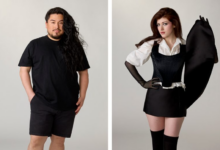

There’s no denying that the finished garment had impact.
When Bryan’s model came down the runway, the material immediately commanded attention. It moved. It caught the light. It created volume. It made the entire garment feel expensive and theatrical.
And sometimes that’s enough to seduce the judges.
But imagine exactly the same silhouette constructed from a plain black fabric.
Would everyone still be calling it the best design of the week?
That’s where I’m not convinced.
Take away the extraordinary textile and you’re left with something much more recognizable:
a caftan.
Beautiful?
Sure.
Wearable?
Absolutely.
But revolutionary?
That’s much harder to argue.
And this is Project Runway.
We’re supposed to be judging design.
A designer absolutely deserves credit for selecting the right fabric. Fabric choice is part of fashion design, and choosing something that transforms dramatically in motion is a skill.
But the fabric shouldn’t become a disguise for a relatively safe idea.
That’s why Bi, Jeffrey, and Jude deserve much more attention in this conversation.
Their looks arguably gave us something Bryan’s garment didn’t:
design decisions that remained interesting even without relying entirely on the textile.
And that’s the test I’d love to give every garment.
Remove the special fabric.
Remove the dramatic runway lighting.
Remove the styling.
Put the garment on a mannequin.
Now ask:
Which design is actually the strongest?
The answer might look very different.
Bryan clearly understood presentation.
And that matters.
A runway isn’t a technical examination.
Fashion is emotional.
If a garment walks out and immediately makes judges feel something, the designer has accomplished part of the assignment.
But that also creates one of Project Runway’s oldest judging problems.
Sometimes the judges seem to reward:
“WOW!”
rather than:
“How did they create that?”
Those aren’t always the same thing.
Bryan’s garment gave them the immediate wow factor.
The fabric entered the runway before the construction did.
It floated.
Moved.
Created spectacle.
The judges saw luxury.
But perhaps Bi, Jeffrey, and Jude required a closer look.
Their work may not have screamed as loudly from twenty feet away, but stronger construction, proportion, originality, or conceptual thinking can reveal itself once you actually examine the garment.
That’s where fans become frustrated.
Because sometimes it feels as though one designer spends hours solving a genuinely difficult design problem…
while another finds an incredible piece of fabric, creates a relatively familiar silhouette…
and wins.
Imagine the judges’ discussion.
One judge says:
“I can’t stop thinking about Bryan.”
Another responds:
“But are you thinking about Bryan’s design or that fabric?”
Silence.
That’s the entire debate.
Because if Bryan had personally manipulated that fabric, transformed it, engineered it, or used complicated construction to create the visual effect, then absolutely—give him enormous credit.
But if the textile already arrived with most of its visual personality built in, then we have to ask how much Bryan actually added.
And that makes Jeffrey particularly interesting.
A designer like Jeffrey can create something that might be less immediately commercial but demonstrates a stronger point of view.
Jude could similarly make judges work slightly harder to understand the garment.
Bi’s look may not create the same explosive first impression, but could feel more sophisticated once examined closely.
Those designers are taking risks.
Bryan’s biggest risk may simply have been trusting the fabric.
And it worked.
That’s smart competition strategy.
But smart strategy doesn’t automatically mean best design.
There’s also another possibility.
Perhaps Bryan understood exactly what the judges wanted better than everyone else.
That’s part of winning Project Runway too.
You aren’t designing inside a vacuum.
You’re designing for judges.
If you know they’re going to respond emotionally to movement and expensive-looking textiles, why wouldn’t you exploit that?
Bryan may have looked around that workroom and thought:
Everyone else is overdesigning.
I’m going to simplify.
Let the fabric breathe.
Let the model sell it.
And if that’s what happened?
Then Bryan played the challenge brilliantly.
But I still wouldn’t necessarily call his garment the strongest.
I’d call it the most effectively presented.
There’s a difference.
And this result could become important later in the season.
Because once judges reward a designer for relatively simple construction elevated by extraordinary material, they’ve established a precedent.
What happens next time another contestant does the same thing?
Will they praise the restraint?
Or suddenly complain:
“The fabric is doing all the work”?
We’ve heard that criticism countless times on fashion competitions.
That’s why consistency matters.
If Bryan gets rewarded for allowing his textile to become the star, another designer should receive the same consideration later.
Otherwise fans are inevitably going to start wondering whether the judging is about the garments…
or about which designers the judges have already decided they like.
And that’s when a controversial win becomes much bigger than one runway.
Because Bi, Jeffrey, and Jude now know something:
Being technically stronger may not be enough.
They need impact.
They need drama.
They need something that photographs instantly.
That realization could completely change how they approach the next challenge.
And perhaps that’s ultimately Bryan’s biggest victory.
He didn’t merely win.
He forced everyone else to reconsider what the judges are actually rewarding.
Still, if I were ranking these looks purely on design rather than fabric impact, Bryan wouldn’t automatically be sitting at number one.
His fabric was spectacular.
His presentation worked.
The garment looked luxurious.
But the silhouette itself?
We’ve been there before.
And if changing Bryan’s fabric would completely change your opinion of the garment, while Bi, Jeffrey, or Jude’s designs would remain interesting regardless of textile…
then maybe the wrong person won.
So did Bryan genuinely create the best dress of the challenge—or did he simply find the best fabric? And if you had the final vote between Bryan, Bi, Jeffrey, and Jude, who would YOU have given the win to?